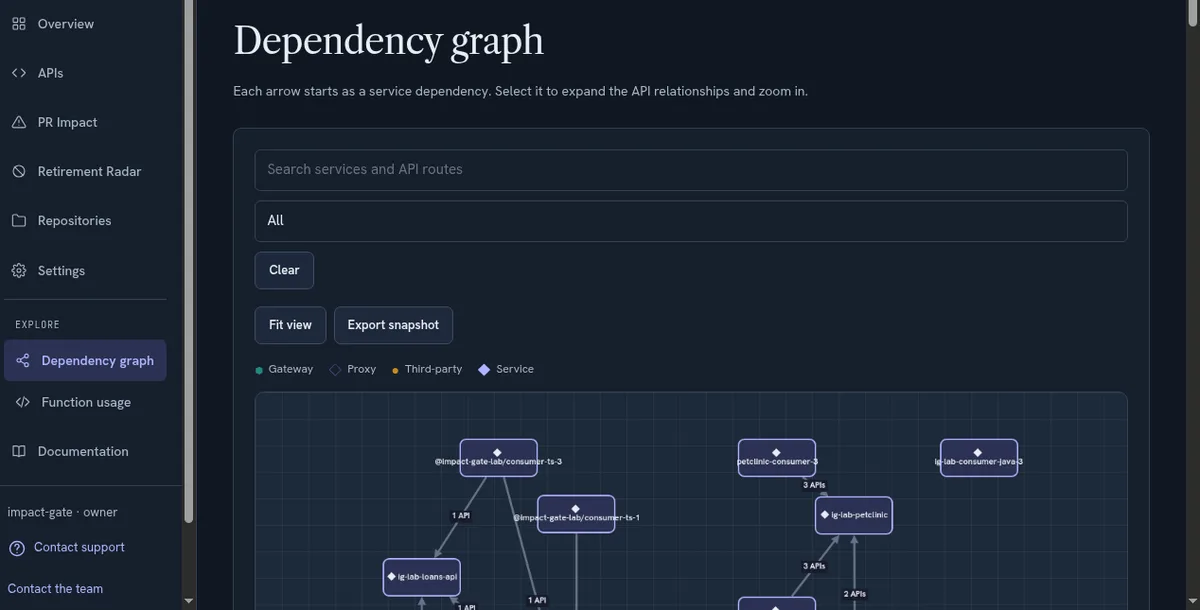
 MAP
API Flows
See the code behind every endpoint.
API-to-code observabilityExplore API flows Read about consumer mappingImpact Gate maps OpenAPI endpoints to services, functions, and consumers across your repositories—then uses that evidence to review pull requests and plan API retirement.
See which downstream services may be affected, with source and uncertainty visible at every step.
No account needed for the demo. Get in touch
A short overview of how Impact Gate follows an API change into downstream code.
Impact Gate combines what your contracts declare, what your repositories expose, and what production telemetry observes. Each result keeps its source and uncertainty visible. Learn how consumer evidence is assembled and how optional runtime evidence fits in.
GET /orders/{id}OrderController → OrderServiceObserved requests · optionalDownstream consumersEvidence-backed next actionUse the same evidence as you understand an API, review a change, and decide what needs a closer look.
MAPSee the code behind every endpoint.
API-to-code observabilityExplore API flows Read about consumer mapping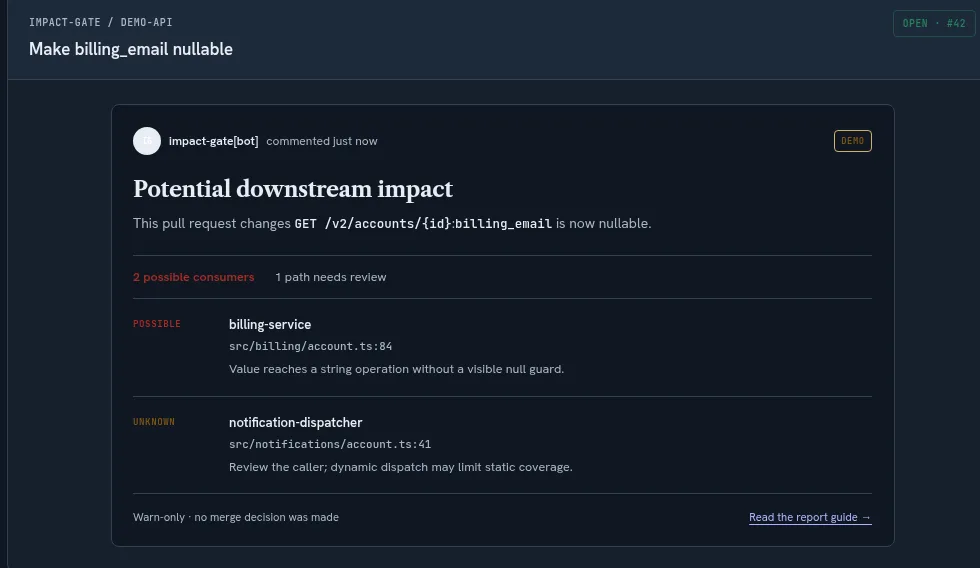 GUARD
See downstream impact before merge.
Downstream break detectionTry the bot demo Read the PR impact guide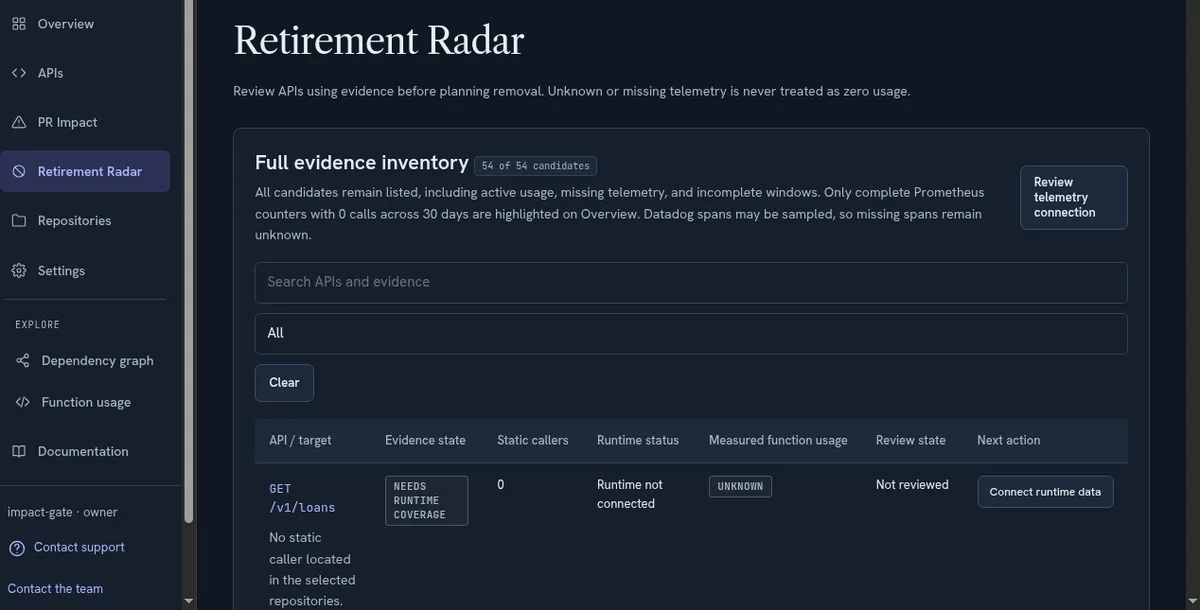 RETIRE
Plan removals with evidence, not assumptions.
Evidence-based API retirementExplore retirement evidence Read the retirement checklistA short walkthrough of the live demo: explore the dashboard, then open a pull request on the demo repository and watch the Impact Gate bot comment.
Impact Gate connects what your contracts declare, what your repositories expose, and what runtime telemetry observes—then keeps source and uncertainty visible.
Start from a changed API contract in a pull request.
OpenAPI changeConnect the changed API surface to indexed downstream callers.
Connected codebaseSurface the trace and leave the decision with the engineering team.
Warn-only outputWhen the connected code does not give a clear answer, the result stays uncertain instead of being treated as no impact.
Runtime telemetry shows API request counts and attributes observed function calls to each API. The source, release, and telemetry quality remain visible.
Static analysis connected the API contract to source code and reachable functions. This describes possible execution, not exact invocation counts.
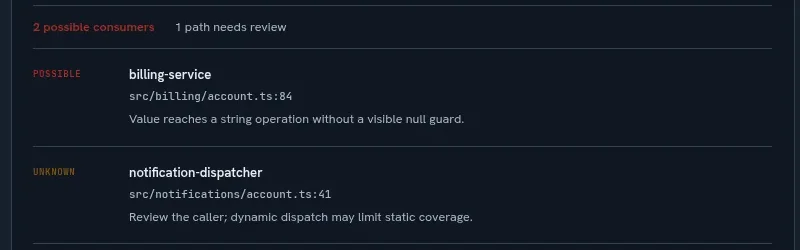
The relationship is plausible but not fully proven. Keep the source reference and the uncertainty visible while reviewing the change.
Coverage, dynamic behavior, or telemetry is incomplete. Missing data is not zero usage and should lead to a clear next action.
Review supported changes to an OpenAPI contract against connected consumer code.
Added, removed, or renamed routes that can change how consumers reach an API.
Schema changes that alter the shape consumers send or receive.
Removed or renamed fields that consumer code may still read.
Values changing between nullable and non-nullable states.
See the full OpenAPI coverage list. Explore all supported change types and analysis coverage.
Impact Gate reviews supported OpenAPI changes against connected, indexed consumer code. Every result is advisory and reflects only the evidence available for review. Runtime data is optional for the static map; Prometheus or Datadog adds API request counts and the function calls attributable to each API.
Impact Gate is open. Connect GitHub and review API changes today.
What is available now and where the boundaries are.
Impact Gate reviews OpenAPI changes against connected consumer code, showing engineering teams which downstream services may be affected and linking potential impact to evidence for review.
Yes. Map, Guard and Retire are open to everyone.
No. The current product posture is warn-only: it presents review information and leaves merge decisions with your team.
The current site describes OpenAPI contract review. Other contract formats are not presented as available.
The result should remain uncertain when source coverage, dynamic behavior, or resolution limits prevent a clear conclusion.
No. Impact Gate uses deterministic static analysis of connected, indexed repositories to trace supported API call paths and show source evidence. Optional Prometheus or Datadog runtime data can add observed request and function-call evidence, but it is not required for the first map. Coverage is limited to selected repositories and supported patterns, so external or dynamic consumers may still be unknown.
Optional model assistance is planned, but it is not enabled or available on the current deployment. Current analysis is deterministic and does not require a model provider.
Have another question? Ask us at info@impactgate.in